
Online Influence & Medical Misinformation: An Inlightened Insights Report
We recently surveyed our network of vetted healthcare professionals to understand how they’re experiencing the growing influence of online mis/disinformation, and what they see on the horizon as new technologies accelerate its spread. The results, revealed today in our new report, Online Influence and the Next Frontier of Medical Misinformation, paint a stark picture of the challenges clinicians face every day in exam rooms, on social platforms, and across the broader healthcare landscape.
The findings show that experts are not only deeply concerned about the impact misinformation has on patients and consumers today; they expect the problem to get worse over the next year, fueled by emerging tools like generative AI, LLMs, and rapidly multiplying video apps.
Specific findings include:
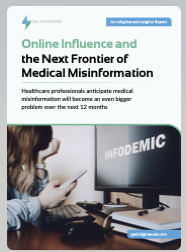
- 61% of respondents report they are concerned “a great deal” about healthcare-related misinformation.
- 79% said misinformation contributes to “acceptance or use of potentially harmful and unproven treatments.”
- 78% said it leads to “a loss of trust in science-backed, proven treatments.”
- 53% report that patients “always” or “usually” come to appointments referencing something they saw on social media—yet 1 out of 3 say that information is “rarely” helpful.
The combination of algorithms, viral content, and the ease of producing credible-looking AI-generated media has created an environment where falsehoods spread faster—and far more widely—than facts. Many say the speed at which new technologies emerge makes it increasingly difficult to keep up—and easier than ever for misleading content to look polished, authoritative, and trustworthy.
 “It may seem harmless, but the potential to create and spread harmful, credible-looking misinformation is vast,” noted Dr. Maryanne Senna, MD, Director of Beth Israel Lahey Health’s Hair Loss Center of Excellence and Research Unit. “At some point, clinicians may simply be fighting false information.”
Despite the challenges, experts identified encouraging pathways to rebuilding trust and strengthening access to evidence-based information. They also shared what would make them more willing to share trustworthy information online. They want to participate, but they need support, infrastructure, and clarity on how to do so safely and effectively.
These findings underscore a growing urgency: misinformation—supercharged by emerging AI technologies—poses a direct and escalating threat to patient safety, clinician credibility, and trust in the healthcare system. As experts continue to face the ripple effects during patient encounters, the need for stronger guidance, more credible voices, and better tools has never been more critical.
For companies operating in digital health, AI, biotech, and healthcare services, the opportunity is clear:
Support qualified healthcare professionals. Equip them with evidence. Elevate trusted voices. And build solutions that restore—not erode—public confidence.
Download the report here.
Inlightened market research veteran, Pam Lintner, on a landmark global commitment to uphold the highest standards of data quality in every facet across the research, insights, and analytics industry.

Discover what U.S. physicians had to say about the future of AI in healthcare — and what it means for innovators like you — in this Inlightened Insights Poll.

Former global pharma executive, Wim Vandenhouweele, leverages his extensive experience and learnings to illustrate how to innovate simply and successfully.